Product Overview


The Single Cell BMS Algorithm Development & Testing Lab from Decibels Lab is an industry-oriented embedded development and learning platform designed for the development, testing, and validation of Battery Management System (BMS) algorithms. Built around the automotive-grade NXP S32K1XX ARM Cortex MCU, the platform enables students, researchers, and engineers to practically implement Model-Based Design (MBD) workflows using MATLAB/Simulink, develop voltage, current, and temperature protection algorithms, perform SOC & SOH estimation algorithms, and deploy embedded C-code directly onto real hardware. The setup integrates real-time sensing, configurable charging and discharge systems, LCD-based visualisation, and MIL/SIL/PIL validation workflows, providing a complete hands-on environment for embedded BMS software development and EV battery engineering education. 


The setup enables students, researchers, and engineers to practically study:

  • Battery Management System (BMS) architecture and workflows
  • Model-Based Design (MBD) using MATLAB/Simulink
  • Voltage, current, and temperature sensing techniques
  • ADC configuration, calibration, and signal processing
  • Over-Voltage (OV) and Under-Voltage (UV) protection logic
  • Over-Current protection for charge and discharge conditions
  • Thermal protection algorithms using NTC sensors
  • Charge and discharge behaviour of Li-ion NMC and LiFePO₄ cells
  • Cell characterisation and C-Rate analysis
  • State of Charge (SOC), State of Health (SOH) estimation 
  • Embedded C-code generation and deployment workflows
  • Real-time telemetry and data logging
  • MIL, SIL, PIL, and hardware-level validation methodologies
  • Charge/discharge MOSFET control and battery safety mechanisms


Learning outcomes using this platform, learners can:

  • Understand the complete workflow of embedded BMS software development
  • Configure and validate sensor acquisition systems for battery applications
  • Develop and test voltage, current, and temperature protection algorithms
  • Implement SOC estimation algorithms using industry-oriented approaches
  • Analyze battery charge/discharge behaviour under different operating conditions
  • Develop Stateflow-based control logic for battery protection systems
  • Generate embedded C-code directly from Simulink models
  • Deploy and validate algorithms on automotive-grade NXP microcontrollers
  • Perform real-time monitoring and telemetry analysis
  • Understand fault handling, hysteresis, and recovery mechanisms in BMS
  • Gain practical exposure to EV battery safety and control strategies
  • Learn debugging, calibration, and hardware validation workflows
  • Build foundational skills required for EV battery and embedded software engineering


The platform integrates:

  • NXP S32KXX Automotive-Grade ARM Cortex MCU
  • MATLAB & Simulink Development Environment
  • Embedded Coder & NXP MBD Toolbox
  • Dual 18650 Cell Support for Li-ion & LiFePO₄ Chemistries
  • Real-Time Voltage, Current, and Temperature Sensing
  • Differential Amplifier-Based Voltage Measurement
  • Shunt-Based Current Sensing with INA301 Amplifiers
  • NTC Thermistor-Based Temperature Monitoring
  • Adjustable CCCV Charging System
  • Multi-Step Constant Current Discharge Load System
  • Charge & Discharge MOSFET Control
  • CAN and UART Communication Interfaces
  • SEGGER J-Link Programming & Debugging Interface
  • LCD-Based Human Machine Interface (HMI)
  • UART-Based Real-Time Telemetry & Logging
  • MIL, SIL, PIL, and Hardware Validation Workflows
  • Real-Time Embedded Deployment & Testing Environment


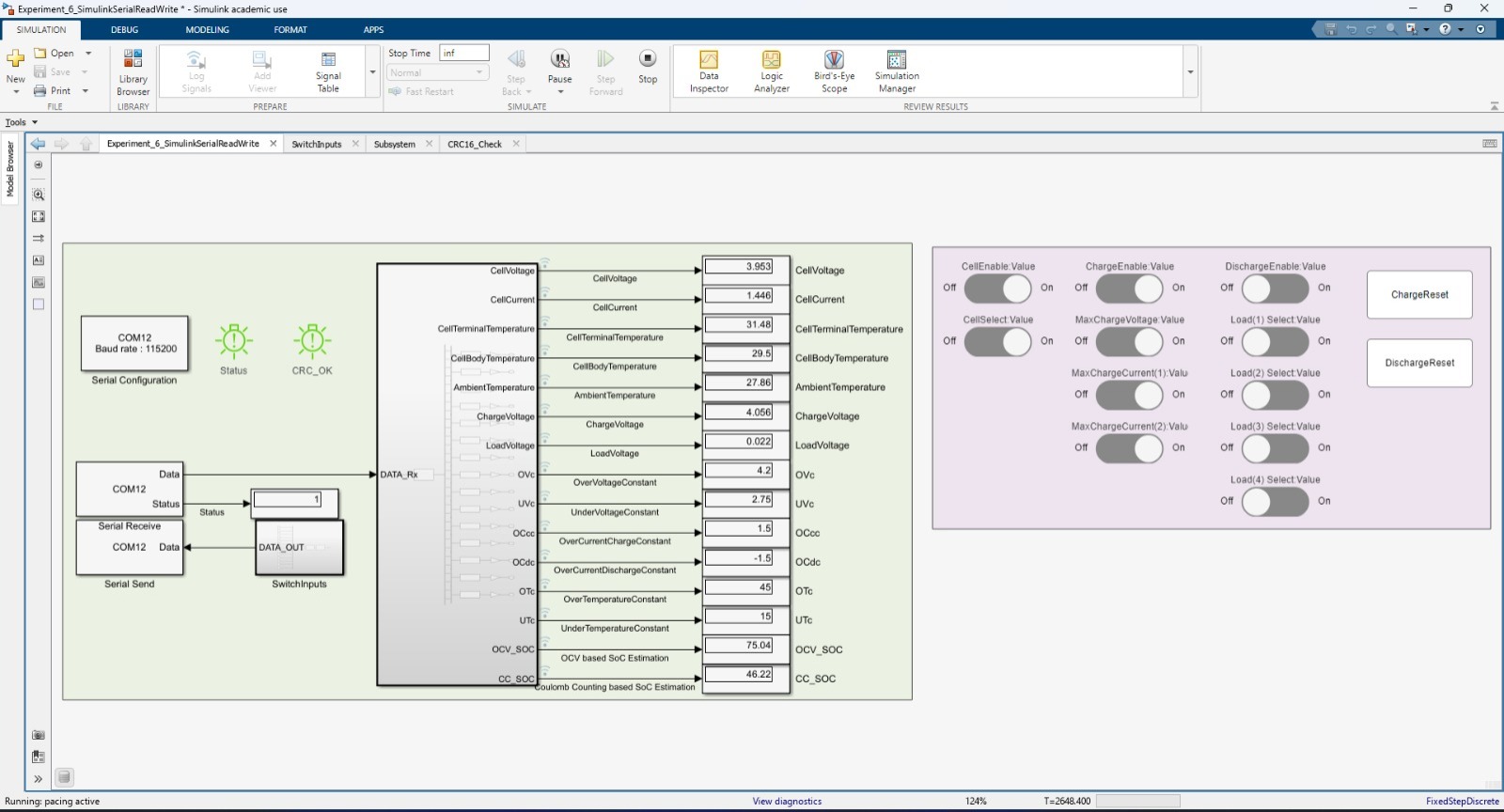
Integrated MATLAB models, data visualisation & data logging 
Product Specifications


Product Features Single Cell BMS
Microcontroller platform NXP S32 KXX
Number of cells options 2
Cell chemistry options NMC & LFP
Voltage measurement ADC
Current measurement Shunt based
Temperature sensing ADC
Maximum current handling 5 Amp
Cutoff option MOSFET based
Protection features MOSFET based
Charging Voltage & current adjustable
Charging profile configuration Yes
Fault indication LED based
SOC estimation OCV / CC / OCV + CC
SOH Capacity counting
Cell Balancing No
Display LED display
Custom code development Yes

Key Experiments You Can Perform

  • Fault Detection and Management

    Develop & Deploy algorithm for Voltage, Overcurrent and Temperature.

  • State of Charge (SOC) Estimation

    Implement and validate various SOC algorithms for NMC & LFP Chemistry.

  • State of Health (SOH) Estimation

    Implement and validate various SOH algorithms for NMC & LFP Chemistry.

  • Model-Based Control System Design

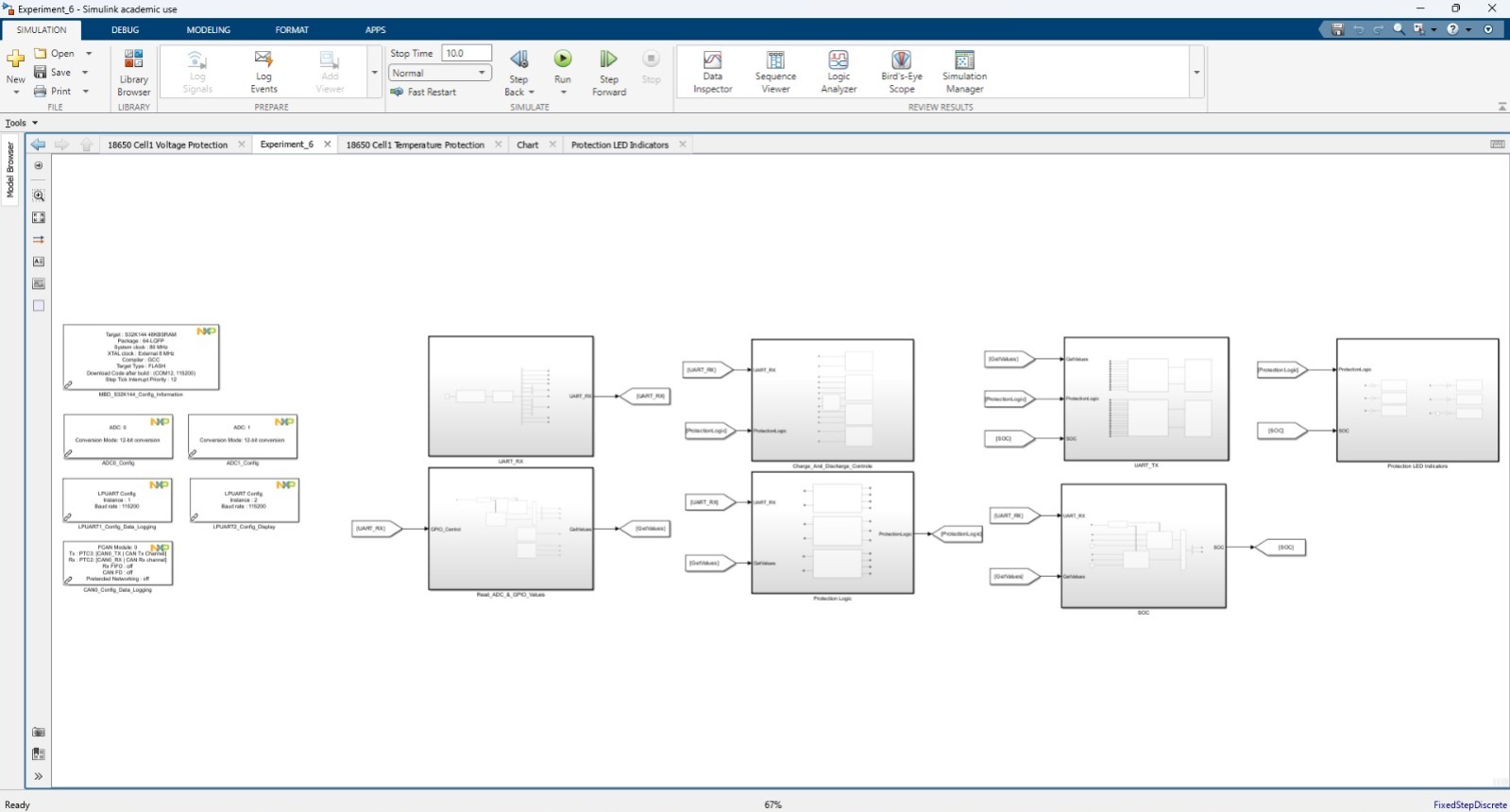
    Use MBDT workflow with MATLAB & Simulink to develop BMS software.

  • Data Logging and Analysis

    Collect, log, and analyze performance parameters during experiments.