
Multi-Cell BMS Algorithm Development & Testing Lab
Develop. Deploy. Validate BMS Systems.
The Multi-Cell BMS Algorithm Development & Testing Lab from Decibels Lab is an industry-oriented development platform designed for learning, developing, testing, and validating Battery Management System (BMS) algorithms for electric vehicle and energy storage applications. Unlike conventional BMS trainer kits that focus only on monitoring or balancing demonstrations, this platform enables complete Model-Based Design (MBD) workflows using MATLAB/Simulink, embedded code generation, real-time telemetry, and hardware-level validation.
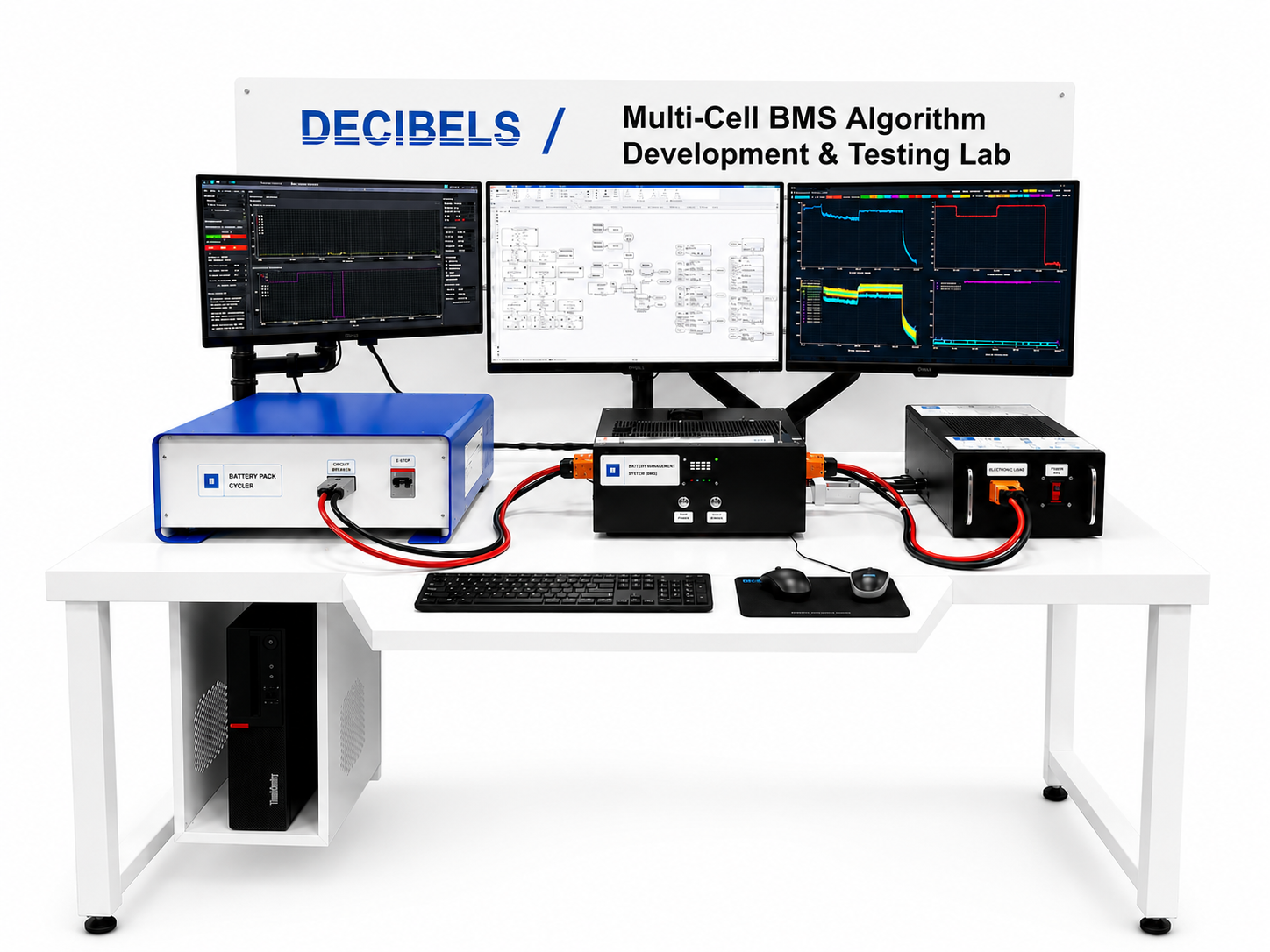
The setup is built around:
Automotive-grade NXP S32K1XX microcontroller
NXP MC33771C battery cell monitoring IC
Multi-cell lithium-ion battery pack
Programmable battery cycler
Real-time communication and telemetry tools
Embedded deployment and debugging workflows
The platform is specifically developed to simulate real-world EV battery management workflows used in the automotive industry.
The setup enables students, researchers, and engineers to practically study:
BMS protection logic development
FET management and precharge sequencing
State-of-Charge (SOC) estimation techniques
State-of-Charge (SOH) estimation techniques
Passive cell balancing algorithms
Model-in-the-Loop (MIL) validation workflows
Embedded C-code generation and deployment
Real-time battery telemetry and monitoring
Hardware validation of BMS algorithms
The platform supports a complete workflow from algorithm development to deployment and physical validation on real battery hardware.
Understand the architecture of Battery Management Systems (BMS)
Develop protection logic for safe battery operation
Configure voltage, current, and temperature protection thresholds
Design and implement SOC estimation algorithms
Develop passive cell balancing strategies
Implement BMS algorithms in MATLAB/Simulink
Build Stateflow-based control logic
Perform Model-in-the-Loop (MIL) validation
Generate embedded C-code using Embedded Coder
Deploy algorithms onto automotive-grade microcontrollers
Monitor and analyse real-time BMS telemetry with custom software from Decibels
Understand EV battery pack safety and operational workflows
The Platform Integrates
NXP S32K146 Automotive MCU
NXP MC33771C Battery Cell Controller
14S Multi-Cell Lithium-Ion Battery Pack
CAN-Based Programmable Load & Charger
MATLAB & Simulink Environment
Stateflow Logic Development
Embedded Coder for Auto Code Generation
Battery Cycler & GUI
Real-Time Data Acquisition & Logging Workflows
The setup creates a complete industry-style EV BMS development environment for learning, experimentation, and advanced battery algorithm validation.

