Product Overview


The Li-Ion Cell Testing & Characterization Lab from Decibels Lab is an industry-oriented cell characterization platform designed for studying the behaviour and performance characteristics of lithium-ion cells used in electric vehicles and energy storage systems. The setup enables students, researchers, and engineers to perform real-time experiments including OCV profiling, capacity characterization, C-rate analysis, coulombic efficiency measurement, round-trip efficiency analysis, and DC internal resistance (DCIR) testing under controlled laboratory conditions. The lab integrates an 8-channel independent cell testing system, real-time data logging, graphical visualization, charge-discharge cycling workflows, and CSV/Excel-based data analysis tools, providing a complete hands-on environment for cell testing, validation, and EV cell engineering education.
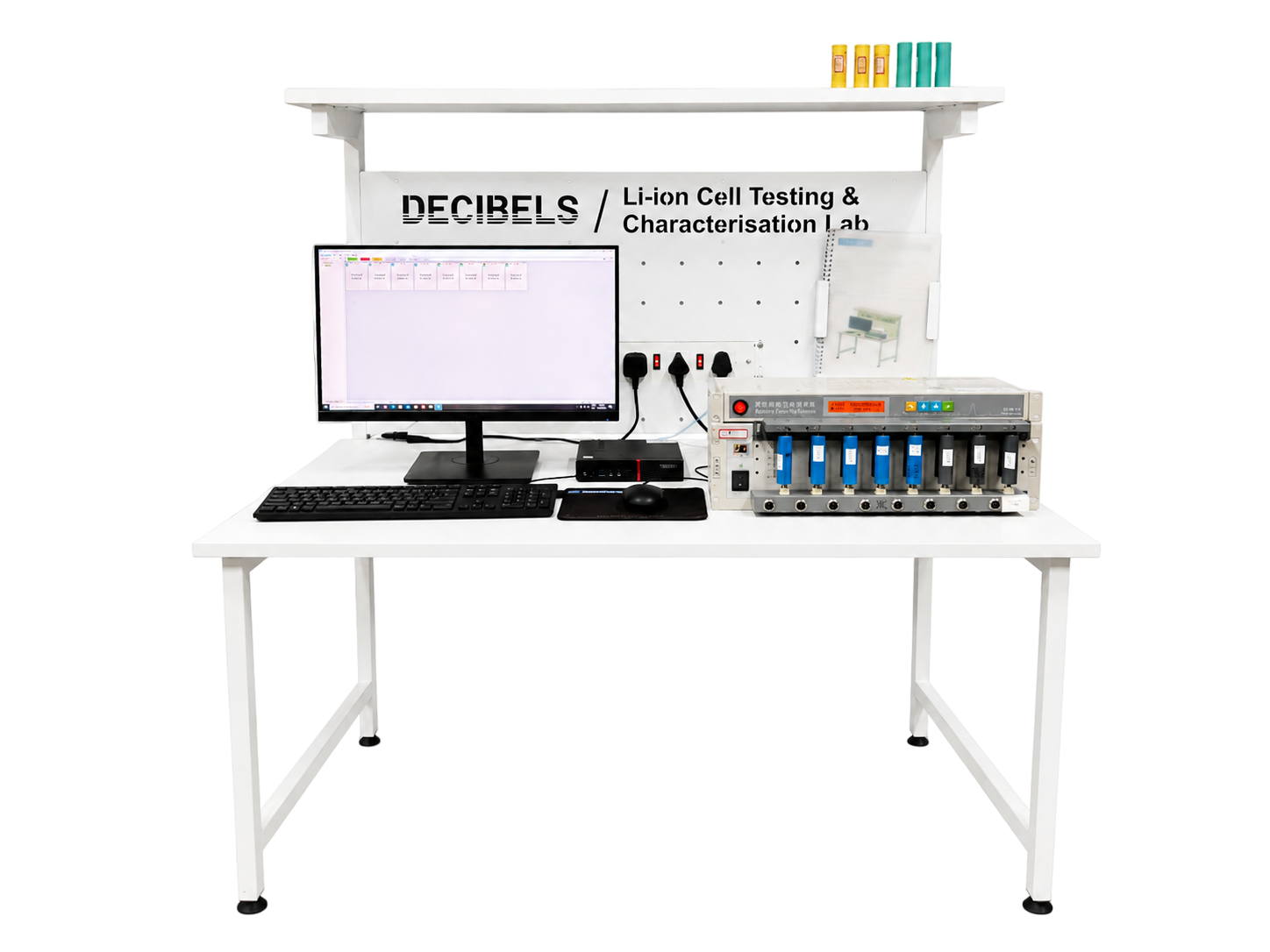


The setup enables students, researchers, and engineers to practically study:

  • Open Circuit Voltage (OCV) profiling of Li-ion cells
  • Cell nominal voltage determination
  • Charge and discharge behaviour of NMC and LFP cells
  • Cell capacity characterisation at different C-rates
  • Effect of discharge current on cell performance
  • Coulombic efficiency analysis
  • Round-trip efficiency measurement
  • DC Internal Resistance (DCIR) analysis using pulse testing
  • Voltage response during charge/discharge pulses
  • Cell degradation indicators and internal losses
  • Voltage vs. discharged capacity characterisation
  • Cell parameter extraction for modelling applications
  • Real-time telemetry and graphical visualization
  • Cell behaviour under varying operating conditions
  • Industry-oriented cell testing and validation methodologies


Learning outcomes using this platform, learners can:

  • Understand the electrochemical behaviour of Li-ion cells
  • Perform OCV, CC, and CCCV-based experiments
  • Measure discharge capacity at multiple C-rates
  • Analyze the effect of C-rate on cell performance
  • Calculate coulombic and round-trip efficiency
  • Perform DCIR measurements using pulse testing
  • Interpret voltage-capacity and pulse-response curves
  • Understand internal resistance and voltage sag behaviour
  • Learn cell characterization methodologies used in EV industries
  • Perform real-time data acquisition and analysis
  • Export and process cell test data using Excel/CSV workflows
  • Understand the influence of temperature, current, and rest periods on cell performance
  • Follow safe handling and testing procedures for Li-ion cells
  • Develop foundational understanding for cell modeling and BMS applications

These learning outcomes are directly aligned with modern EV cell testing and characterization workflows. 


The platform integrates:

  • 8-Channel Independent Li-Ion Cell Testing System
  • Simultaneous Multi-Cell Testing Capability
  • Support for NMC & LFP Chemistries
  • CCCV Charging Workflows
  • Constant Current (CC) Discharge Testing
  • Real-Time Voltage & Current Measurement
  • High-Speed Data Logging System
  • Graphical Visualization & Plotting Interface
  • PC-Based cell Cycler Control Software
  • CSV / Excel Data Export Capability
  • OCV, Capacity & DCIR Characterization Workflows
  • Pulse-Based Internal Resistance Testing
  • EV cell Research & Educational Experiment Modules
  • Safety-Oriented Testing Procedures & Protection Guidelines

Product Specifications


Specification Variant 1 – 5V15A 8 Channel Variant 2 – 5V30A 8 Channel
Product ID DB-CTC-A01 DB-CTC-A02
Machine Rating 5V 15A, 8 Channels 5V 30A, 8 Channels
Input Power 826 W 2127 W
Input Voltage AC 220V/110V ±10%, 50Hz AC 220V/110V ±10%, 50Hz
Voltage CV Output Range 25 mV – 5 V 25 mV – 5 V
Output Range/Channel 0.2 A - 15 A 0.15 A – 30 A
CV Cut-off Current 2 mA, 12 mA, 24 mA 2 mA, 12 mA, 24 mA
Power Per Channel 75 W 150 W
Min Data Record Interval 100 ms 100 ms
Min Voltage Change 10 mV 10 mV
Data Recording Frequency 10 Hz 10 Hz
Accuracy ±0.05% FS ±0.1% FS
Stability ±0.05% FS ±0.1% FS
Channels Per Unit 8 8
Max Cycles 65,535 65,535
Voltage & Current Testing Sample 4-wire connection 4-wire connection
Communication Port Ethernet Ethernet
Dimensions (W×D×H) 483 × 563 × 130 mm 600 × 600 × 740 mm
Supply Consists Of Test equipment, DAQ, AIO computer, UPS, Custom table & Manual Test equipment, DAQ, AIO computer, UPS, Custom table & Manual
Online Course Access 1-Year: Installation & Cell Testing Fundamentals 1-Year: Installation & Cell Testing Fundamentals

Key Experiments You Can Perform

  • Charge-Discharge Cycling

    Analyze charging efficiency, discharge profiles, and performance degradation over multiple cycles.

  • Capacity Measurement & Energy Efficiency

    Determine usable capacity under constant and dynamic load conditions.

  • Cycle Life & Degradation Analysis

    Evaluate the long-term performance of different chemistries and their aging trends.

  • Rate Capability Testing

    Study how cells respond to various current rates (C-rates), assessing thermal and voltage behavior.

  • Open Circuit Voltage (OCV) Profiling

    Capture OCV vs. SOC curves for calibration and BMS algorithm design.

  • Internal Resistance Measurement

    Measure and analyze internal resistance over time and its effect on performance. hec